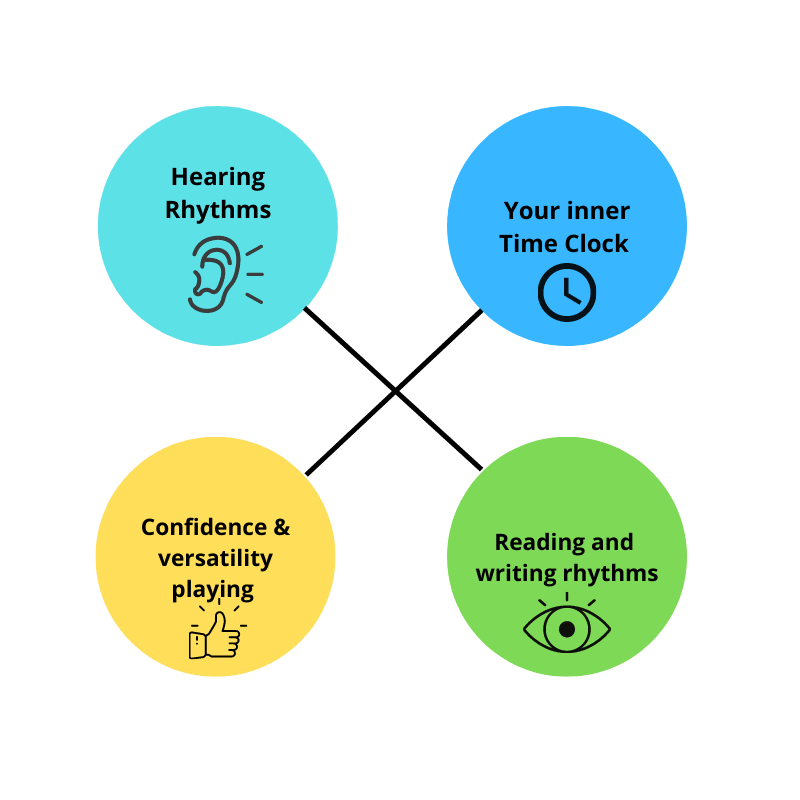
When it comes to developing rhythm skills, working to broaden the number of strumming patterns, grooves and feels we are comfortable with helps us in a variety of ways:
- It means there are more rhythms that are available to you in your own composition and accompaniment choices.
- It becomes easier to hear and transcribe rhythms present in songs and pieces of music, some of which may be played on guitar; but some of which you may need to create a guitar part for, as a composite of different rhythmic elements going on in the song. Identifying the important aspects of a rhythm and being able to translate them to guitar means you can play arrangements of all kinds of songs that may not have had their most recognisable rhythm played on guitar originally.
- It develops your internal ‘rhythm clock’ so that all the playing you do feels more solid, and so that the accompaniment you might provide to other instruments or while you sing feels and sounds consistent.
- It makes you more versatile as a guitarist and that’s more exciting and enjoyable.
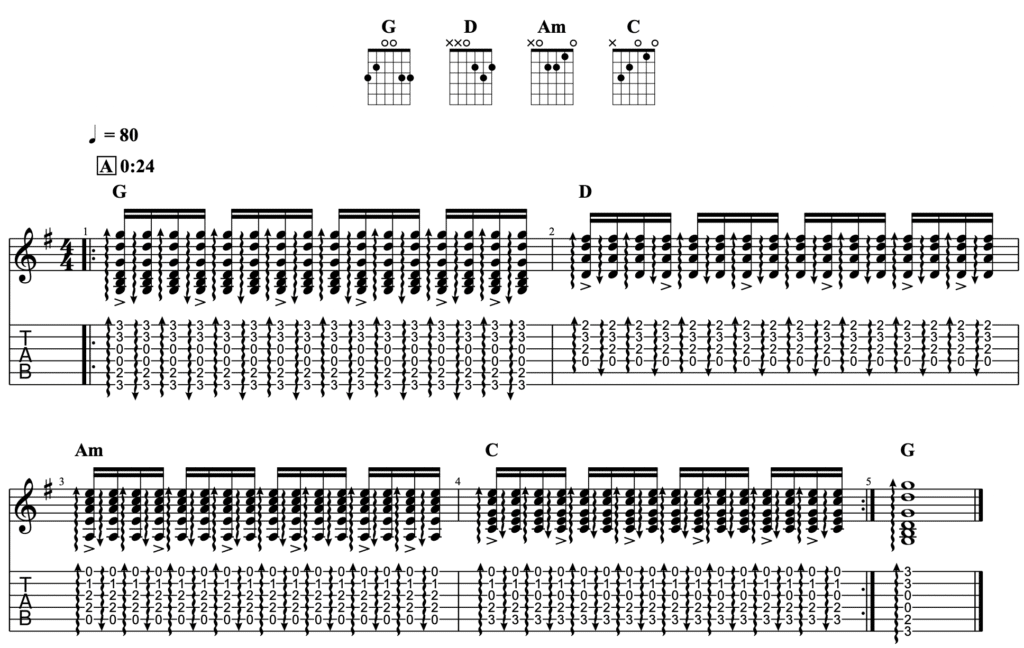
There are five grooves on this page. For each groove, check you can understand the notation and review any aspects of it that you haven’t seen before. It’s fine to read the notation through with muted strumming first.
Each groove uses chords, some of which are standard open chords, some of which are common variations that you may not have seen yet, some of which are barre or partial barre chords. Take a moment to check the chord diagrams. Whilst expanding your chord vocabulary and building stamina for barre shapes is a great extra component of this material, our priority is the rhythms, so if you need to switch out some chords to be able to play the rhythm accurately while you’re building up the fluency with the chords, do so.
Your progression with this material is:
- Understanding: to understand the notation. NB: this notation has the downstroke marked in as a line from the lowest string to the highest, and an upstroke marked from highest string to lowest.
- Application: play with muted strings, play with backing track or metronome with muted strings (this trains your overall internal rhythm clock and your ability to sync with an external rhythm source – a separate skill to strumming rhythmically by yourself), then play with the chords as written.
- Integration: Using this at greater depth would include playing the rhythms with other chords; switching between different rhythms (as you might in different sections of a song), switching between lead and rhythm; switching between different types of rhythmic accompaniment (like fills and bass notes and strums).
It may take some time before you get to number 3. There is no rush! But it’s helpful to have some idea in mind of the ways you can evaluate how deeply integrated material is, and what will be available to you when you have it thoroughly assimilated.
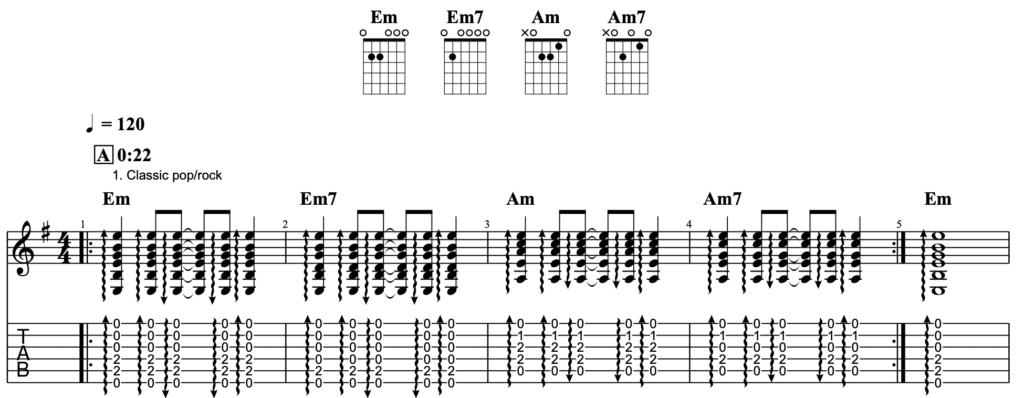
- Classic Pop / Rock strumming pattern. Useful in many situations!
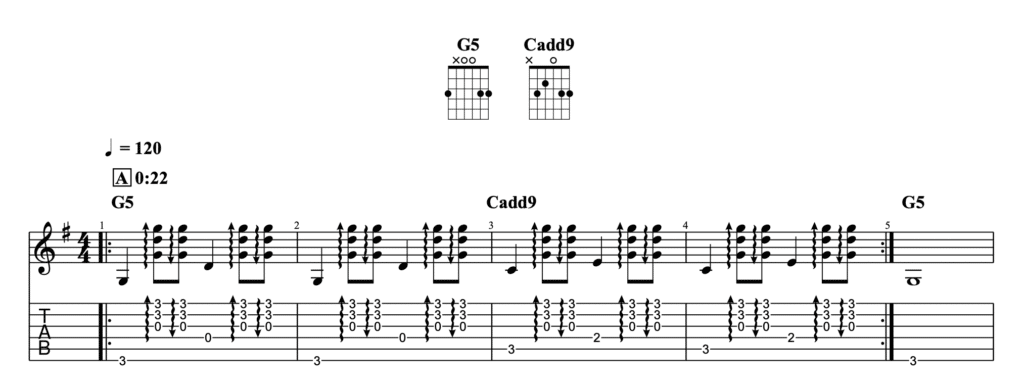
2. Country. The Cadd9 is a common variation. This will challenge picking accuracy on the low strings. This style of strumming can add a lot of movement and momentum to your rhythm accompaniments.
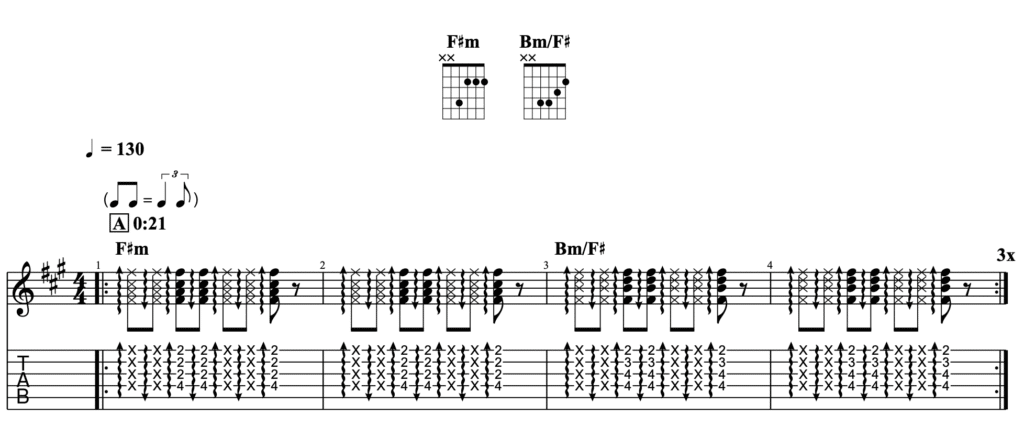
3. Reggae can be challenging as a rhythm to play when you’re not used to it, partly because the drum grooves are a bit different and you really have to count and tap your foot to keep track of where you are.
4. This ballad rhythm has accented 16th notes that create a rolling feel.
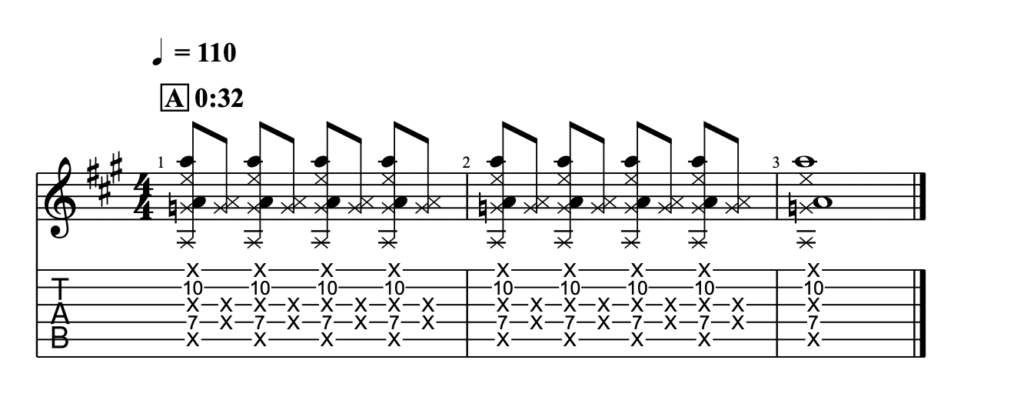
5. Staccato pop rhythm. This uses octave chords and you want to mute the other strings with your left hand. This type of guitar part usually works best as a counterpart to other rhythms present in an ensemble. The backing track is highly syncopated and it’s this type of rhythm that will sound good with an octave quarter note part.
Application training:
- Play one chord progression for each cycle of four or two bars depending on the example. Then switch to another chord (either the next in the sequence or one of your choosing). This means you have to keep track of how many bars you’ve played.
- Increase the frequency of the chord changes! If they change every bar, try to switch to playing each chord for half a bar.
- See if you can switch between two different rhythms seamlessly. Examples 1, 2, and 4 will combine well and although it is a bit more challenging switching from on the beat to off the beat, you adapt 3 as well.
- What keys could the examples be from and what material do you have available to play single notes in those keys? Can you play a major or minor pentatonic in the rhythm that’s written? What about switching between a bar of lead or fills and going back seamlessly into the rhythm?
- It can sound very cool going between open chords and triads if you want to play a bar of strumming and a bar of melodic single notes.